Everyone Wants Community. No One Wants to Talk Back.
Let's get real.
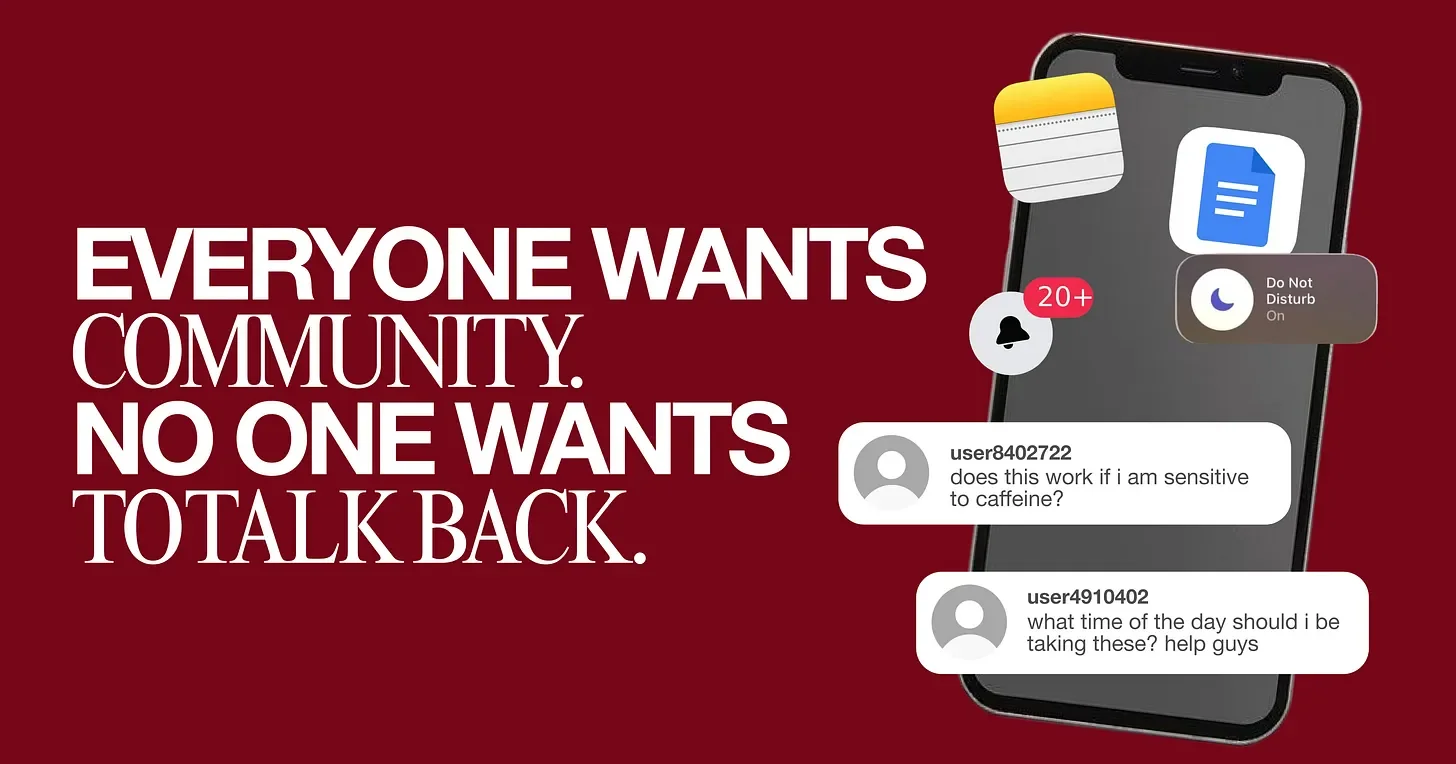
“Community” has become one of the most overused words in marketing.
It’s in Instagram bios, anchors pitch decks, and shows up in strategy slides as a core pillar:
Build community. Deepen community. Activate community.
But scroll through most brand comment sections and a different story unfolds. Unanswered questions, thoughtful responses with no acknowledgment, customers tagging friends and sharing experiences into silence. The language says community. The behavior says campaign. There is a difference. Community is dialogue. Engagement is a metric. And the brands that understand that distinction are quietly pulling ahead.

Asking Questions Isn’t the Same as ListeningMany brands believe they are fostering conversation because they are asking for it.
“Which one are you choosing?”
“Drop your goals below.”
“Comment YES if this is you.”
The comment count rises, the engagement rate looks healthy, the post performs well. But asking a question is not the same as being prepared for the answer.
What happens when someone responds with:
“I want to try this, but I’m nervous about side effects.”
“I’ve used something similar before and it didn’t work.”
“Can this fit into a busy schedule?”
If those comments sit unanswered, the brand isn’t building community. It’s collecting participation. True community requires reciprocity, if someone contributes, they expect acknowledgment. If someone expresses hesitation, they expect clarity. If someone shares a win, they expect to be seen and without response, participation becomes one-sided.
The Comment Section Is Not an AfterthoughtMost brands treat the comment section as cleanup work. Something to manage after the post has gone live. Something to monitor for customer service issues. That mindset is outdated. Your comment section is not the aftermath of your content. It is the beginning of your next piece of content.
Every question is a signal. Every objection is insight. Every repeated phrase is data about how your audience thinks and speaks. If someone asks, “Does this work if I am sensitive to caffeine?” that is not just a single comment. That is a window into hesitation. That is friction in the buying journey.
If three people ask it, that is a pattern. If ten people ask it, that is a content series waiting to happen. The comment section is a live focus group. And you do not have to pay for it.
The Four Comment Types Brands Should Actively MineInstead of viewing comments as noise, brands can categorize them into four strategic buckets.
1. Clarifying Questions
These are the most straightforward opportunities.
Examples:
“How often should I use this?”
“Can this be stacked with other supplements?”
“Is this beginner-friendly?”
Rather than answering once and moving on, turn the answer into durable content.
Create an FAQ Reel addressing the top three recurring questions.
Develop a carousel titled “You Asked, We Answered.”
Add a pinned Story highlight for common concerns.
One thoughtful reply can become evergreen education.
2. Objections and Skepticism
These comments often feel uncomfortable, which is why many brands ignore them.
Examples:
“Why is this more expensive than competitors?”
“Is this actually different from other options?”
“This seems overhyped.”
Avoiding these questions weakens trust. Addressing them strengthens it. When a brand publicly explains sourcing, research, testing standards, or formulation decisions, it demonstrates confidence and transparency. Openly handling skepticism signals maturity and it shows there is substance behind the marketing.
3. Success Stories
Positive comments are frequently acknowledged with a quick “We love this!” and left at that.
But testimonials are not just compliments. They are conversion assets.
If someone shares a detailed experience:
Ask permission to feature it.
Turn it into a community spotlight.
Screenshot and incorporate it into a carousel.
Use their exact language in a future hook.
User stories humanize the brand. They shift messaging from claims to proof.
4. Language and Emotional Cues
The most subtle category is also the most powerful. Pay attention to the words your audience uses.
Are they saying:
“I feel behind.”
“I’m overwhelmed.”
“I don’t know where to start.”
“I just want something simple.”
If your messaging focuses on optimization and performance, but your audience is asking for simplicity and clarity, there is a disconnect. Strong brands adapt their hooks to reflect audience language, not internal jargon. When people feel understood, they lean in.

A Practical Comment-to-Content WorkflowTo operationalize this, brands can implement a simple weekly system.
1. Conduct a Weekly Comment Audit
Set aside 15–20 minutes. Pull comments from your top-performing posts. Document them in one place.
2. Categorize and Label
Tag each comment:
Question
Objection
Testimonial
Emotional language
3. Identify Repetition
If a theme appears more than once, it matters. Repetition signals priority.
4. Assign Content Formats
Recurring question → FAQ video
Common objection → Myth-busting carousel
Compelling testimonial → Spotlight post
Emotional friction → Founder explanation or educational Reel
5. Close the Loop Publicly
When the new content goes live, reply to the original commenter:
“We expanded on this in our latest post.”
Tag them, pin the original comment if relevant, and make listening visible. This reinforces that comments are not disappearing into a void.
What Community Actually RequiresCommunity is not built through broadcast frequency. It is not built through trend participation.
It is not built through high comment counts alone. It is built through response.
When people feel heard:
They comment again.
They share.
They advocate.
They defend the brand in conversations you are not present for.
When they feel ignored:
They disengage.
They observe silently.
Or they leave.
Engagement metrics measure activity and community measures relationship depth. The brands that will win are not necessarily the loudest or the most aesthetic, they are the most attentive. Everyone claims they are building community. The differentiator is simple:
Are you prepared to talk back?